


At a glance
Cogno uses Microsoft Teams resource-specific consent (RSC). Installing Cogno authorizes only the specific Team, group chat, or meeting chat where it is installed—not every conversation in the organization. You then decide which channels to import and which eligible chats to include. Project assignment comes later.
Human-to-human one-to-one chats are not supported. Group chats with two or more people and meeting chats are supported when Cogno is installed in that conversation.
Before you start
- Ask your Microsoft 365 administrator how Cogno is distributed in your organization. Cogno may be available through your organization’s app catalog, or your administrator may need to upload a Cogno-provided package for a limited rollout.
- Use a member work or school account in the target Microsoft tenant. Personal Microsoft accounts and guest-only accounts cannot complete account verification.
- Confirm that you can manage integrations in the target Cogno Workspace.
- Confirm that you are a current member of each Team or chat you want to connect.
Make Cogno available in Microsoft Teams
Your Microsoft 365 administrator completes one of the following paths. If you do not know which path is available for your organization, contact your Cogno representative. Do not upload a package from an unverified source.Option 1: Use the organization app catalog
1
Open the Teams app list
In the Microsoft Teams admin center, open Teams apps → Manage apps.
2
Find Cogno
Search for Cogno. Confirm that App status is Unblocked and that the intended users are included in Available to.
3
Adjust access if needed
If Cogno is blocked or unavailable to the intended users, update the organization’s Teams app settings before continuing.
Option 2: Upload the Cogno package for a limited rollout
1
Get the package from Cogno
Obtain the
.zip app package from your Cogno representative. The package must match the environment you are connecting.2
Upload the app
In Teams apps → Manage apps, open Actions, choose Upload new app, and select the package.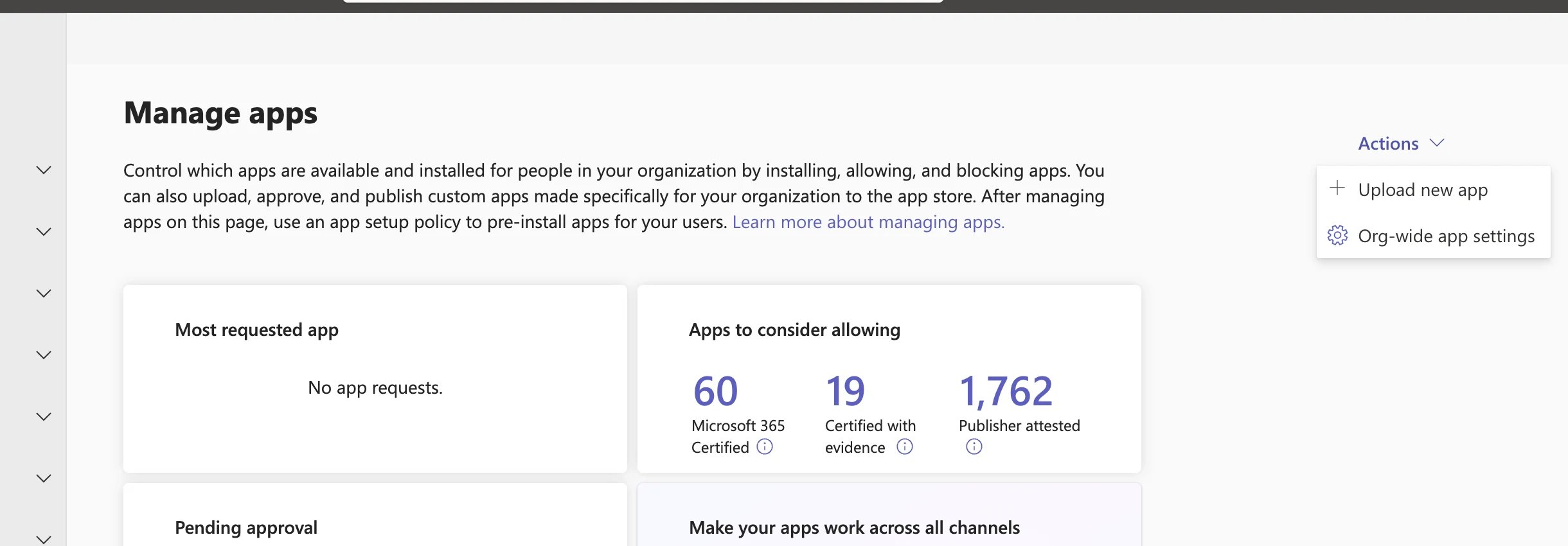
3
Confirm availability
Search for Cogno and confirm that App status is Unblocked and the intended users are included in Available to. Microsoft notes that an uploaded app can take a few hours to become available.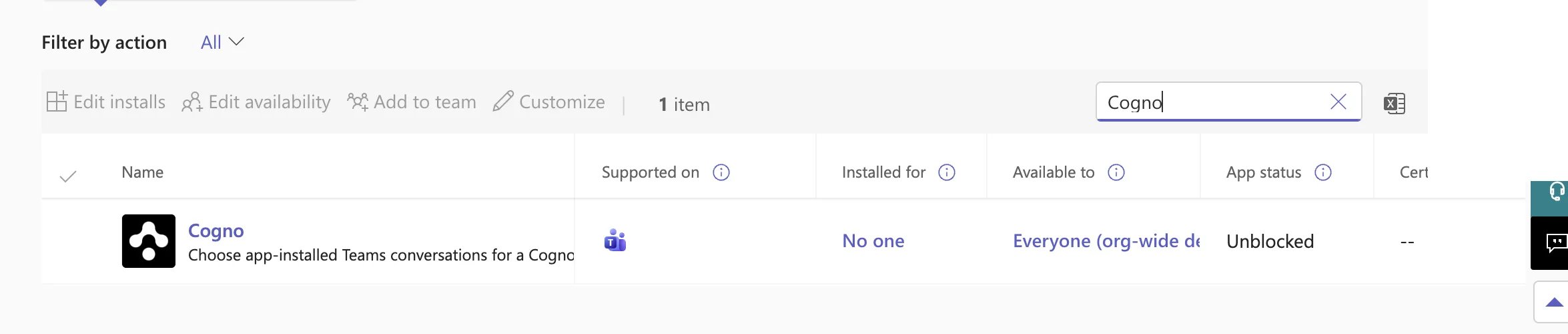
The Team owner or chat member sees the requested permissions when adding the app. These permissions do not grant tenant-wide access.
Connect Microsoft Teams in Cogno
1
Open Microsoft Teams settings
In Cogno, open the target Workspace, go to Integrations, find Microsoft Teams, and choose Connect. Choose Resume instead if setup is already pending.
2
Sign in to Microsoft
Complete Microsoft sign-in with your member work or school account. On Cogno Desktop, sign-in opens in your default browser and then returns to the app. If it does not return automatically, choose Open Cogno on the completion page.
3
Complete admin approval
When Admin approval required appears, choose Open admin approval. If another person is the Microsoft tenant administrator, choose Copy approval link and send the short-lived link to that person. Cogno checks the result automatically.
4
Select a Team
At Team selection pending, open Select a Team, select one Team, and choose Connect Team. Use Load more Teams if needed.
5
Confirm the connection
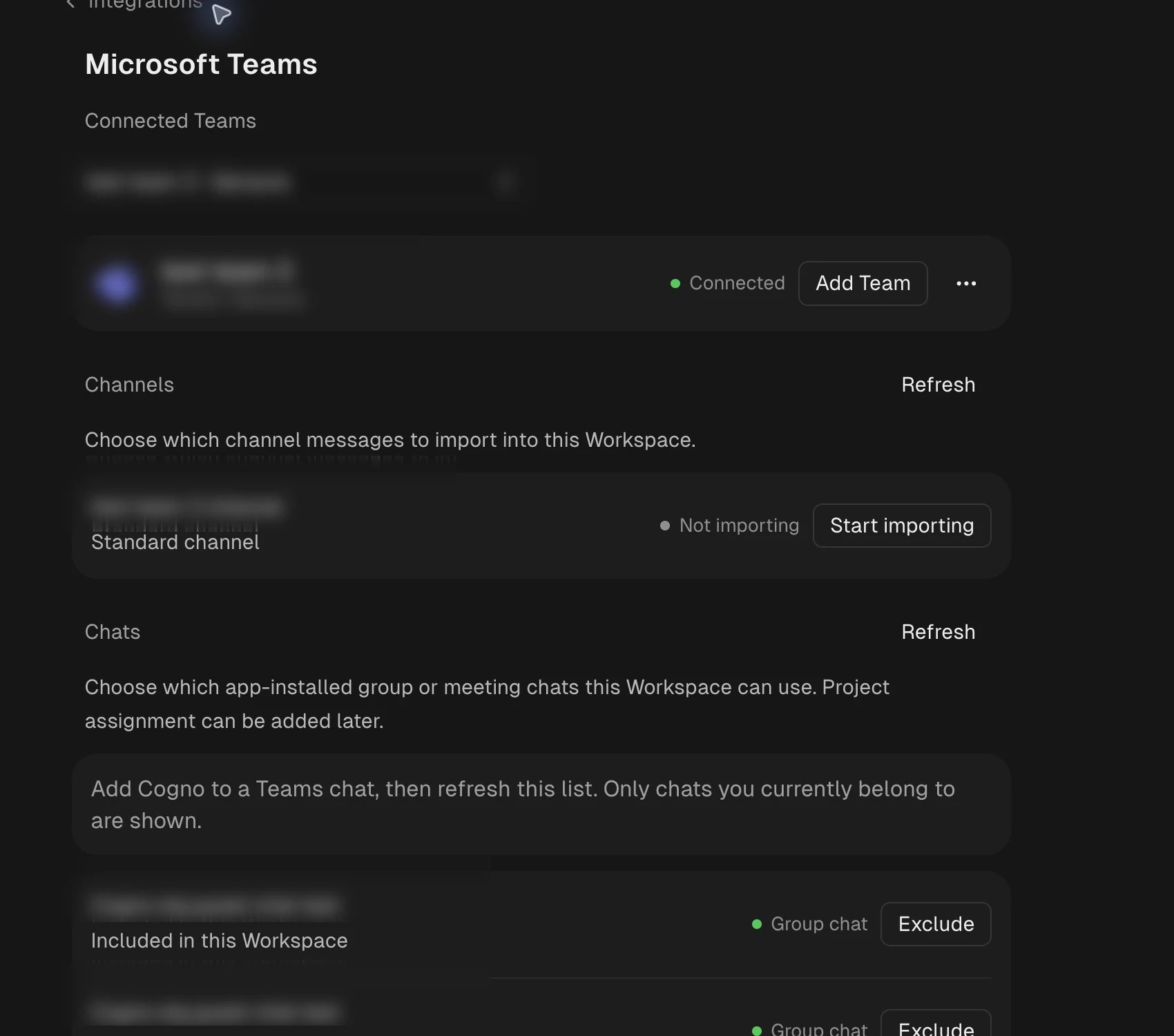
Confirm that the Team row shows the Team name, Microsoft tenant name, and Connected. Use Add Team to connect another Team to the same Workspace.
Start or stop channel imports
Under Channels, choose Start importing beside every channel whose new messages should become Workspace events. Choose Stop importing to stop one channel without affecting the others.
Use Refresh to reload the list and Load more channels to retrieve additional channels. Viewing status requires Workspace access; changing an import requires integration management permission.
Include a group or meeting chat
1
Add Cogno to the conversation
In Microsoft Teams, open the group chat or meeting chat, add an app, and select Cogno. Review the RSC permissions and complete the add flow. No connection code or setup message is required.
2
Verify your Microsoft account
Return to Cogno’s Microsoft Teams settings. If prompted, choose Verify Microsoft account and sign in with the account that belongs to the target chat. Cogno stores the verified account identifiers, not Microsoft access or refresh tokens.
3
Refresh eligible chats
Under Chats, choose Refresh. Cogno lists only chats where the app is installed and the verified account is currently a member.
4
Include the chat
Choose Include. New messages can now become Workspace events, and the chat is offered to every Project next to the Team’s channels. Choose Exclude to stop new-message events; Projects that selected the chat lose access at the same time.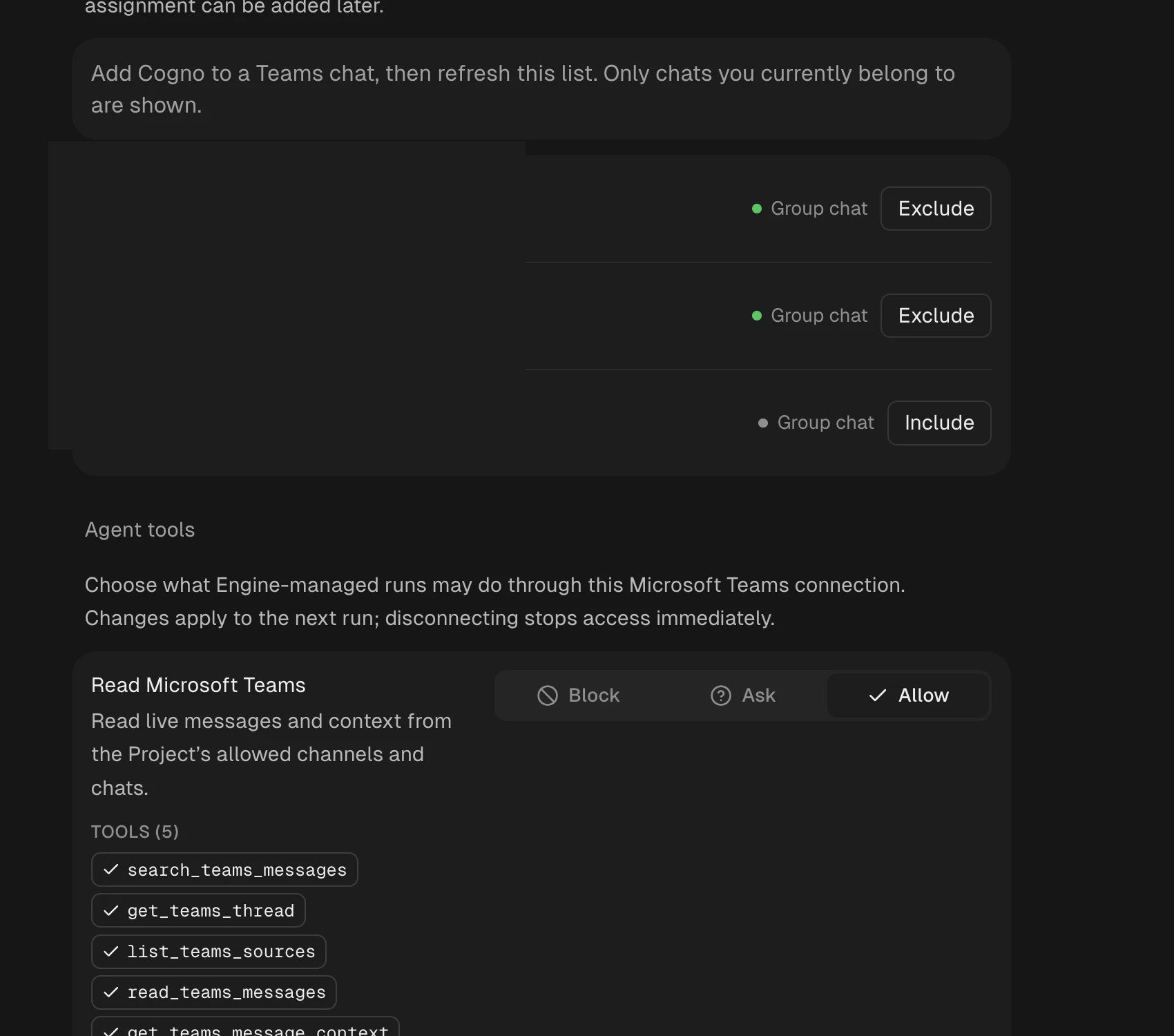
Choose sources for a Project
Workspace inclusion and Project access are separate, and they work the same way for channels and chats:- The Workspace decides what Cogno may see at all: importing channels, and including app-installed chats, under Integrations → Microsoft Teams.
- Each Project decides what it takes from that: open the Project’s Integrations settings, enable Microsoft Teams, and select channels and included chats from the same list. Any number of Projects may select the same chat.
- Deselecting a chat in one Project changes nothing for the others. Choosing Exclude in the Workspace withdraws the chat from every Project at once.
Control agent read access
In the connection’s Agent tools section, Read Microsoft Teams controls five read-only tools:search_teams_messagessearches recently stored channel messages.get_teams_threadreads the stored thread around a search result.list_teams_sourceslists the channels and chats the current Project selected.read_teams_messagesreads a bounded page directly from Microsoft for one listed source.get_teams_message_contextreads bounded context around one Microsoft message.
Send messages and replies
Send to Microsoft Teams controlssend_teams_message and reply_teams_message separately from read access. Writes start with Block. Choose Ask for approval during attended runs, or Allow for automatic delivery. A Project may apply a stricter setting.
The Cogno app must be installed in the target Team or chat before enabling writes. Existing installations do not need updating solely to enable these tools. Messages are posted as the Cogno bot to a channel or a group/meeting chat selected for the Project. Replies use a root message returned by the live read tools. Messages are limited to 10,000 characters. Thread replies are supported in channels. File uploads, reactions, edits, and deletions are not supported by these tools.
Channel reads use the Microsoft application authorized when connecting the Team; they do not require a separate bot installation. Chat reads still require the app in that chat and the chat’s inclusion in the Workspace. Connected, Importing and Included do not by themselves grant Project access; the Project’s own selection does.
If Microsoft does not confirm a send, Cogno reports an unknown outcome and refuses automatic resending. Check Teams before trying another delivery.
Verify the connection
1
Send a recognizable message
Post a harmless, unique test message in an importing channel or included chat. Do not use confidential customer content for the test.
2
Confirm the source is active
In Cogno’s Microsoft Teams settings, confirm that the channel shows Importing or the chat shows Included.
3
Test agent access
Assign the source to a test Project, set Read Microsoft Teams to Allow or Ask, and ask an agent in that Project to read the recent Teams message. The agent should only see sources selected for that Project.
Disconnect
Select the Team under Connected Teams, open the ⋯ menu on its row, choose Disconnect, and confirm the Team name. Cogno stops imports for that connection. Other connected Teams remain active.Common states
Reference URLs
- Microsoft: Manage apps in the Teams admin center
- Microsoft: Upload and manage custom apps
- Microsoft: Add an app to Teams
- Microsoft: Resource-specific consent permissions
- Microsoft: Manage consent to apps